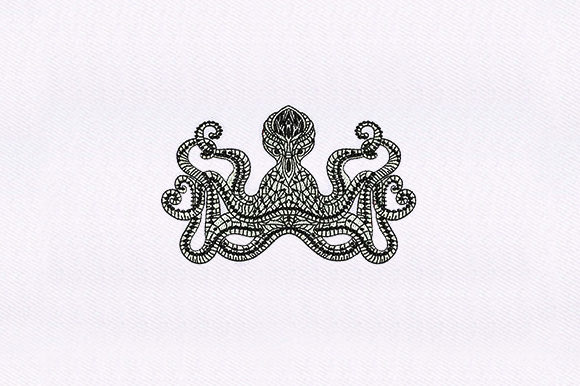
Mandala Octopus: A Designer’s Real-World Review
As someone who’s stitched hundreds of designs across apparel, home goods, and boutique merchandise—and who’s turned down more than a few embroidery files for being overpromised or under-executed—I approached Mandala Octopus with quiet curiosity. Not hype. Not hope. Just attention.
I’d already committed to a small-batch run of organic cotton tote bags for a local herbalist’s pop-up shop—minimal branding, intentional details, nature-infused calm. The Mandala Octopus landed in my inbox the same week. I opened it not as a buyer, but as a designer assessing whether this machine embroidery design would hold up in real life: on textured fabric, under store lighting, in customers’ hands, and across repeat orders.
First Impression: Calm Complexity, Not Clutter
The Mandala Octopus isn’t loud. It doesn’t shout “look at me.” Instead, it invites slow looking—the kind that happens when someone pauses mid-browse at a craft fair booth or lingers over a handmade gift tag. The octopus form is softened by mandala geometry: concentric rings, symmetrical tentacle flourishes, and subtle negative space between motifs. It feels meditative, not mystical; grounded, not generic.
Unlike some mandala embroidery files that drown in repetitive fill stitch or sacrifice legibility for density, this one breathes. Tentacle tips taper cleanly. Petal-like segments retain shape even at 3.5 inches wide. There’s no visual competition—no forced contrast, no competing line weights. That matters. When you’re stitching on a linen tea towel or a baby onesie, clarity isn’t decorative. It’s functional.
Where It Shines (and Where It Asks for Care)
I tested Mandala Octopus across five real project types: a heavyweight cotton sweatshirt, a lightweight rayon-blend scarf, a curved baseball cap, a woven cotton apron, and a quilted pillow cover. Here’s what held up—and where I adjusted.
- Tote bags & aprons: Ideal. The balanced stitch density anchors well on medium-weight woven fabrics. No puckering. No thread nesting—even with variegated cotton thread layered over beige canvas.
- Sweatshirts & hoodies: Works cleanly with tear-away + cutaway stabilizer combo. Tentacle edges stayed crisp; no “fuzzing” along satin-stitched curves. Recommend avoiding placement directly over seam allowances unless you pre-stabilize seams.
- Baby items & onesies: Excellent—if you reduce size to 2.75" max and confirm hoop clearance. The design’s inherent softness reads as gentle, not busy—a win for nursery decor or milestone gifts. Just double-check that inner fill areas don’t create stiff patches against delicate skin.
- Caps & curved surfaces: Proceed thoughtfully. The outer ring holds fine, but tight inner loops compress slightly on high-crown caps. I rehooped twice before settling on a flatter front-panel placement—not center crown. If you’re selling embroidered caps commercially, test on your exact blank first.
- Dark or textured fabrics: Mandala Octopus gains presence on charcoal terry cloth or black denim—but only with high-contrast thread (e.g., ecru on black). On heavily napped fleece or bouclé, skip the innermost filigree layers unless you’re willing to manually edit stitch order or reduce density.
What It Adds to Your Finished Product—Beyond Aesthetics
This isn’t just about how Mandala Octopus looks. It’s about how it makes your product *feel* to the person holding it.
A customer receiving a Mandala Octopus–embroidered kitchen towel doesn’t just get utility—they get intention. The symmetry suggests care. The organic flow implies hand-guided rhythm, even when stitched by machine. That perception elevates perceived value, especially for Etsy sellers pricing handmade products at $48–$68. It also builds trust: buyers recognize when a design isn’t slapped on, but *lived into* the item’s purpose.
For small shop owners building cohesive branding, Mandala Octopus works as both hero motif and subtle accent. Stitch it large on a boutique apron, then echo one tentacle segment as a tiny chest logo on matching tea towels. That kind of continuity—achieved without custom illustration—is rare in off-the-shelf embroidery files.
Designer Notes You’ll Actually Use
Before you load Mandala Octopus into your machine or list it in your digital shop, do these six things:
- Test on scrap fabric—not just the same fiber, but the same weight and finish as your final product. Linen behaves differently than linen-look cotton. Rayon slinks; cotton holds.
- Check thread color contrast in natural light. What reads as distinct on screen may blur on oatmeal twill. Try a single-color version first—especially if offering monochrome embroidery options.
- Review stitch density in your embroidery software. Dense fill areas near the center can cause stiffness on lightweight garments. Consider reducing density by 5–8% for babywear or scarves.
- Confirm hoop size compatibility. If your smallest hoop is 4"x4", Mandala Octopus fits comfortably. If you regularly use 3.5"x3.5" hoops, verify the design clears borders at your intended scale.
- Inspect small details at 200% zoom: Are inner loops fully stitched? Do any satin-stitch transitions look abrupt? One misplaced jump stitch can unravel visual harmony.
- Verify licensing terms before selling finished items or bundling Mandala Octopus as part of a digital embroidery bundle. Commercial use rights aren’t automatic—even for “high-quality embroidery” files.
Final Thought: Not Every Mandala Needs to Spin
There’s a quiet confidence in Mandala Octopus. It doesn’t try to be everything. It doesn’t cram in extra petals or force symbolism. It settles into its shape—and asks you to do the same. Whether you’re stitching a personalized gift for a yoga teacher, launching a capsule collection of embroidered kitchen linens, or adding depth to your craft fair booth, this design earns its place. Not because it’s trendy, but because it stitches true, reads clearly, and carries weight—without weighing anything down.