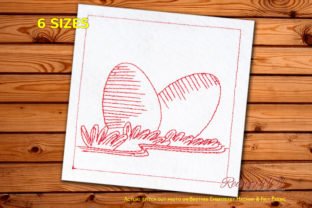
Easter Egg Redwork: A Designer’s Real-World Stitch Test
As someone who’s stitched hundreds of holiday designs for clients—from boutique baby blankets to Etsy-ready tote bags—I opened Easter Egg Redwork with quiet curiosity, not hype. This isn’t a flashy 3D puff or glitter-heavy motif. It’s line art. Clean. Deliberate. And in the right hands, quietly powerful.
First Impression: Simplicity That Speaks Volumes
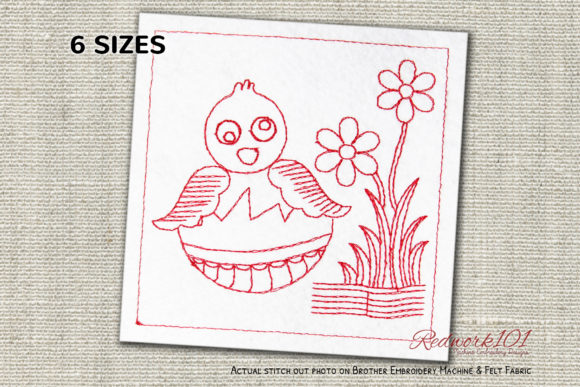
The moment you preview the design, you feel its rhythm: a single, confident outline of an Easter egg—slightly elongated, softly tapered at both ends, with subtle internal lines suggesting gentle curvature and delicate detail. No fill stitch clutter. No dense satin borders. Just running stitch and fine satin work defining shape and contour. It reads as handmade—not machine-made—because it trusts the stitcher’s eye and the fabric’s texture to complete the story.
This isn’t a design that shouts “Easter!” It whispers it—elegantly. That makes Easter Egg Redwork ideal for projects where charm lives in restraint: a linen tea towel for a spring kitchen, a minimalist baby onesie, or a neutral-toned apron for a small-batch bakery. It avoids cliché while still landing unmistakably in the season.
Where It Shines (and Where It Asks for Thought)
I tested Easter Egg Redwork across three real project types: a medium-weight cotton tote bag, a 100% cotton baby bodysuit, and a structured twill cap. Here’s what held up—and what needed attention.
- Tote bag: Perfect. The clean lines translated crisply on the stable, low-stretch surface. I used a light tear-away stabilizer and standard 40-weight red thread—no puckering, no distortion. Customers notice this kind of clarity; it reads as intentional, not rushed.
- Baby bodysuit: Worked beautifully—but only with a cut-away stabilizer underneath and careful hooping. Thin knits demand respect. Without proper support, the running stitch lost definition near the neckline curve. Still, the result was soft, breathable, and utterly appropriate for newborn gifting.
- Cotton twill cap: Tricky—but doable. The curved surface compressed some of the finer internal lines. I resized the design down 5% and rehooped with cap-friendly foam stabilizer. Outcome? Subtle, sophisticated, and far more refined than typical holiday cap embroidery.
That said, Easter Egg Redwork isn’t built for every surface. Avoid it on highly textured fabrics like bouclé or thick terry cloth—the line work will blur. Skip it on stretchy performance knits unless you’re willing to test extensively with adhesive + cut-away combo stabilizers. And never assume it’ll pop on dark fabric without adjusting thread contrast: a true red on navy works, but a faded brick red won’t.
Design Integrity Meets Commercial Reality
What makes Easter Egg Redwork stand out for craft businesses isn’t just aesthetics—it’s reliability. As an embroidery designer, I’ve seen too many “cute” Easter files unravel mid-stitch: tangled jump stitches, inconsistent density, or tiny details that vanish on anything but premium stabilizer. This one doesn’t do that.
The stitch density feels balanced—not so sparse it floats, not so dense it stiffens lightweight fabric. There are no micro-details smaller than 1.2mm, meaning it scales cleanly from 3” to 5” without losing legibility. That’s gold for Etsy sellers offering multiple sizes of embroidered pillow covers or personalized sweatshirts.
For small shop owners, Easter Egg Redwork strengthens brand consistency. Its quiet confidence pairs well with earthy palettes, natural fibers, and slow-made positioning. When customers see it on a handmade apron or a nursery wall hanging, they don’t think “holiday clipart”—they think “thoughtfully made.” That perception lifts perceived value, builds trust, and encourages repeat purchases beyond Easter.
Practical Designer Notes Before You Stitch
Before adding Easter Egg Redwork to your next batch of custom apparel or digital embroidery file listings, run these checks:
- Test on scrap fabric first—especially if using textured, dark, or stretchy materials. See how the line weight holds up after washing.
- Review thread color contrast in both natural and artificial light. Red-on-cream reads differently than red-on-charcoal.
- Confirm hoop size compatibility. While the design is compact, verify it fits comfortably within your smallest hoop with room for movement.
- Inspect small corners and curves in your embroidery software. Look for any abrupt direction changes that could cause thread breaks on older machines.
- Try black-and-white mockups before finalizing product photos. Line art relies heavily on contrast—what looks bold on screen may fade on fabric.
- Use appropriate stabilizer: light tear-away for stable wovens, cut-away for knits, and cap-adhesive foam for curved items.
- Check licensing terms before selling finished items or bundling the embroidery file digitally. Not all machine embroidery designs permit commercial use out of the box.
A Design That Earns Its Place
Easter Egg Redwork won’t dominate a holiday catalog—but it might become your most-requested custom addition. It’s the kind of embroidery file that elevates a plain sweatshirt into a meaningful gift, turns a basic tea towel into a curated kitchen staple, and gives a baby embroidery project quiet heirloom energy.
It’s not flashy. It doesn’t need to be. In a market saturated with overdesigned seasonal motifs, this line art egg reminds us that sometimes the strongest statement is the simplest stitch—placed with care, chosen with intention, and stitched to last.
If you're curating embroidery project assets for your craft business—or selecting a design to represent your brand during the Easter season—Easter Egg Redwork earns its spot not through volume, but through voice.